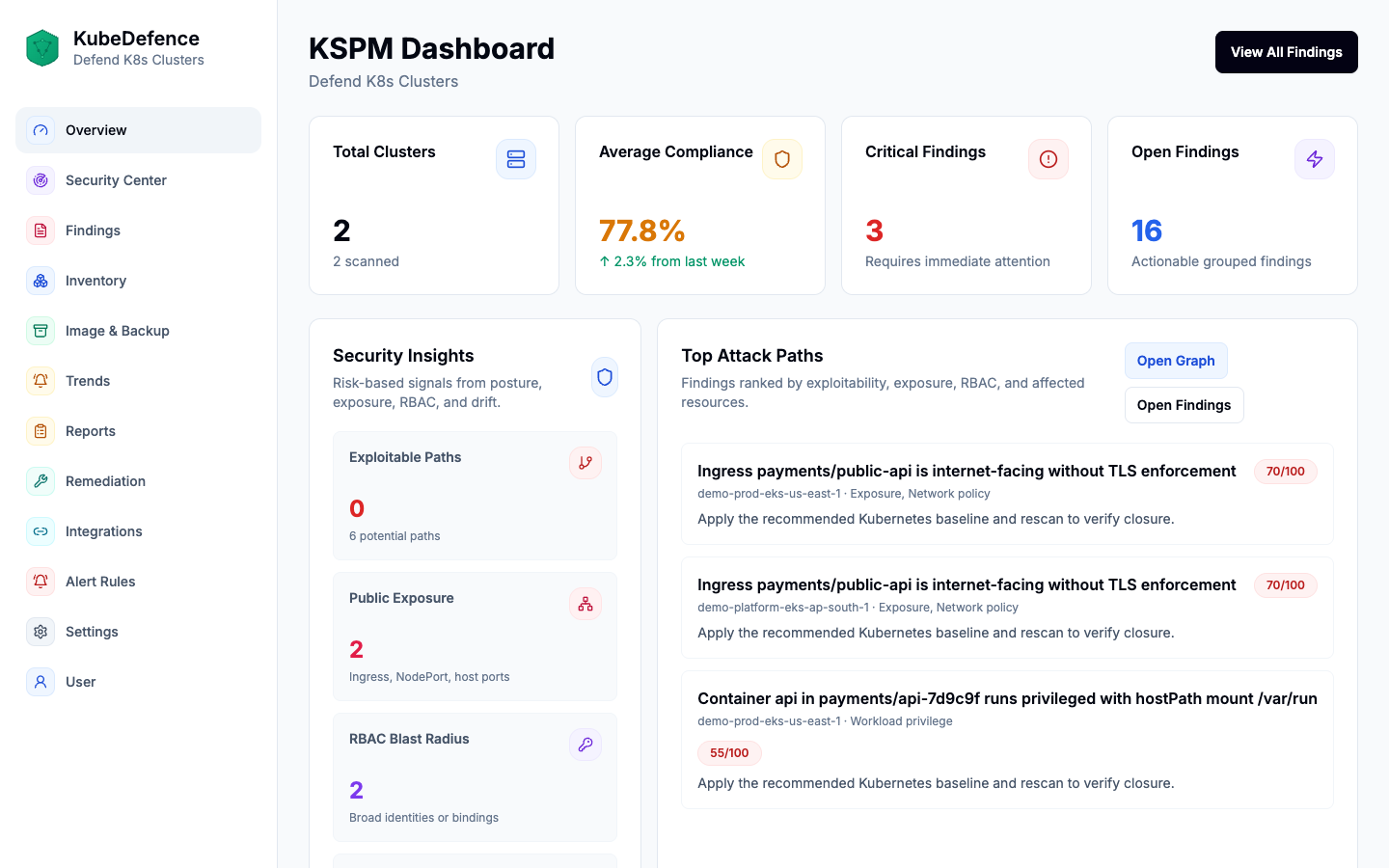
K8s attack-path evidence for regulated teams

Find the attack path before it becomes an incident.

KubeDefence maps ingress, workload, image, identity, node, backup, and compliance evidence into one operational trail for Kubernetes security reviews. Teams can see what is reachable, what is exploitable, and what proves the fix.

Open Evidence Console
Ingress-to-workload path RBAC blast radius Image CVE evidence S3 cluster backup CIS/NIST audit reports
Case KD-042 Internet exposure to secrets path
Critical
01 Exposure Public ALB ingress External traffic reaches checkout API
02 Route Service selects live pod Not a stale config, real workload traffic
03 Image Critical RCE CVE Running image digest is vulnerable
04 Identity Broad service account RoleBinding expands secrets impact
05 Impact Namespace secrets exposed Evidence package ready for review
PathIngress, service, pod, image, identity, impact
5 hrScheduled scans plus on-demand investigation
AgentHeartbeat, workload evidence, and drift signals
S3Recoverable full cluster backup snapshots
Evidence workflow

A security review flow built around proof, not noise.

KubeDefence is built around the questions that come up in real reviews: what is exposed, which workload is reachable, what identity can do damage, and which evidence proves the fix.

01

Enroll customer clusters

Install a lightweight, low-overhead DaemonSet-based agent to collect node, workload, image, RBAC, exposure, and compliance signals from shared K8s clusters.

02

Correlate real exposure

Move beyond flat severity by correlating public access, privileged containers, service accounts, image risk, namespace policy, and runtime context.

03

Prove every remediation

Track evidence from detection to remediation with affected resources, scan history, agent heartbeat, and compliance-ready reporting.

04

Retain operational evidence

Add image scanning and full cluster backup-to-S3 workflows so teams can assess running workloads and retain recoverable cluster state. Restore actions stay gated behind RBAC and explicit approval workflows.

Security pain points

Kubernetes risk is no longer one isolated misconfiguration.

Modern cluster risk is a chain: exposed entry point, vulnerable image, broad service account, privileged pod, weak network policy, and missing evidence.

Exposure without context

Before: public service alertAfter: exposed workload path

A public LoadBalancer or ingress only matters when you can see the workload, image, service account, namespace controls, and blast radius behind it.

Flat findings overload

Before: duplicate alertsAfter: grouped fix priority

Teams lose time when every misconfig looks equal. KubeDefence shows why a finding matters and which resources are actually affected.

Manual audit evidence

Before: screenshots and sheetsAfter: retained evidence trail

Audit preparation is painful when cluster inventory, CIS checks, image evidence, backups, and remediation status live in separate tools.

KubeDefence capabilities

From posture checks to evidence-backed attack paths.

We are building KubeDefence around the workflows security teams actually need: collect agent telemetry, correlate exposure, prioritize exploitable paths, fix, prove, and retain evidence.

Attack Path Sequencing

Connect cloud account or environment, K8s cluster, namespace, workload, pod, container, image, service account, RBAC, exposure, and findings into a readable risk path.

Exposure Detection

Identify public LoadBalancers, risky ingress, missing NetworkPolicy, hostNetwork, hostPort, weak TLS, and sensitive namespace exposure.

Risk-Based Prioritization

Rank issues by severity plus exploitability signals like internet exposure, privileged execution, secrets access, broad RBAC, and running workload status.

Image Scanning

Scan running pod images, cache by image digest, surface critical and high CVEs, and tie image risk back to exposed workloads.

Cluster Backup to S3

Create full Kubernetes cluster backups in your S3 bucket for audit, review, and operational evidence. Restore workflows stay gated through product RBAC, approval chains, and controlled testing to avoid accidental overwrite risk.

Evidence Timeline

Show when an issue appeared, which scan detected it, which resources are affected, whether runtime behavior was observed, and when it was fixed.

Why agent based KSPM matters

Explain the attack sequence, not just the finding.

Security teams need to understand how a real attacker could move. KubeDefence uses agent telemetry and posture evidence to connect exposure, service routing, workload identity, image risk, and secrets access into one readable attack path.

Attack sequence 6 signals
01 Public ingress internet exposed
02 Service route traffic reaches pod
03 Running pod live workload
04 Image CVE critical exploit path
05 Broad RBAC identity blast radius
06 Secrets access data impact
Selected signal Public ingress
Source
ALB, Service, Ingress
Evidence
Internet listener routes to a production namespace.
KubeDefence action
Show exact exposed workload path.

Hover or tap a signal to see how KubeDefence explains that layer of the attack sequence.

Security demo

See the KubeDefence workflow in action.

Preview the real product flow across dashboard posture, security center, findings, inventory, image scanning, and cluster backup workflows.

Open Evidence Console
Evidence console

One evidence layer for every Kubernetes security decision.

Correlate inventory, CIS checks, exposure paths, image scans, runtime direction, backup evidence, and remediation status so platform, security, and audit teams can explain risk from the same live source of truth.

Paths sequence for every priority
Evidence for scans and fixes
S3 full cluster backups
LIVE EVIDENCE STREAM 87%

"The useful part is not another scanner. It is seeing the exposure path, the affected resources, and the evidence that proves the fix worked."

Cloud Security Lead, Fortune 500 FinTech Company Multi-cluster platform team
Attack path visible Image risk attached Cluster backup retained
Roadmap and goals

Where KubeDefence is heading.

Our goal is to become the Kubernetes defense layer that combines posture, cloud context, runtime signals, evidence, and remediation into a product teams can trust every day.

Now Available

KSPM foundation

K8s onboarding, agent telemetry, cluster inventory, grouped findings, attack paths, severity-based triage, remediation, reports, integrations, image scanning, and full cluster backup-to-S3 requests.

Next In Progress

Cloud and exposure correlation

Cloud provider context for worker pools, IAM or service roles, security groups, public endpoints, load balancers, network exposure, audit change signals, and drift detection.

Future Design Partner Phase

Falco/eBPF runtime defense

Falco and eBPF-based runtime detections for reverse shells, suspicious process execution, container escape indicators, sensitive file tampering, and unexpected egress.

Reduce alert fatigue Prove compliance faster Prioritize exploitable risk Protect shared K8s clusters
Pricing direction

Designed around clusters, nodes, and evidence retention.

Pricing should scale with how much Kubernetes surface area we protect and how much evidence customers need to retain.

Starter

For teams validating KSPM on a small K8s footprint

$499/month
  • Up to 3 clusters
  • Automatic posture scans every 5 hours
  • CIS and workload findings
  • Inventory and grouped resources
  • 30-day evidence retention
  • Email support

Enterprise

For regulated teams and large Kubernetes platforms

Custom
  • Unlimited clusters
  • Custom retention and reporting
  • Private customer-cloud deployment option
  • SSO and product RBAC roadmap
  • Falco/eBPF runtime sensor design partnership
  • Dedicated onboarding support
  • Custom evidence exports

Ready to defend your Kubernetes fleet?

Use KubeDefence to find exposed workloads, prioritize exploitable risk, prove remediation, and build a stronger Kubernetes security operating model.

Open Evidence Console

Pilot-ready • K8s-focused • Built for posture, attack paths, evidence, and runtime direction

Connect with Us

Talk to the KubeDefence team

Reach out for product demos, investor conversations, enterprise pilots, or deployment questions.